


eBook – Rhythmic Permutations
The idea of writing my music and drum instructional books started about ten years ago. Since then, their designs and contents have evolved multiple times. After studying and graduating in drums, classical percussion, and jazz at the Luca School of Arts in Belgium, I began to teach, laying the first foundations for my books’ content.
There, at the start of 2019, I began travelling the world, pushing book ideas to the background—until King Island, where I borrowed a drum kit. With no books or literature, I wrote my own exercises again. A couple of months and a week in isolation later, I proudly present my first eBook, Rhythmic Permutations.
eBook – Rhythmical Permutations:
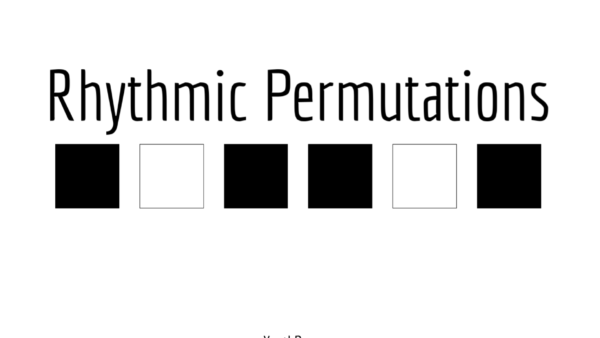
Rhythmic Permutations
My first eBook, Rhythmic Permutations, stands apart from typical books because it has no classical notation and no lengthy instructions. It serves as a visualization of the permutations concept. There are multiple books to write about this concept, but beyond my planned online drum lessons, that will be for future releases. For those familiar with rhythmic permutations, this eBook is full of visualized rhythmic options. If you are new to permutations, the eBook logically orders all possible rhythmic combinations within a specific number of beats, using white dots to represent all beats and a black dot to show the rhythm. The notation-free design keeps options open so the player can make their own subdivisions.
What’s inside this eBook?
The first chapter covers 3-beat variations, followed by 4, 5, 6, 7, 8, 9, 10, 11, and 12-beat ones. This yields 8,174 rhythms across 107 pages—ideal for studies, exercises, and reading. It forms a rhythmic archive and strong foundation for advanced knowledge, but deeper experimentation reveals endless possibilities. It is a book full of rhythmic possibilities.
Permutations explained
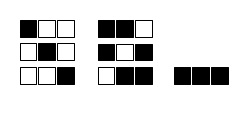
Technically speaking, permutations and combinations share mathematical roots. In these systems, black dots methodically explore every combination possible within a framework of fixed white dots. Take a 3-dotted system: it generates three single-black-dot positions (1, 2, 3), then three double-black-dot combinations (1-2, 1-3, 2-3), with the final all-dots-filled state making seven total combinations (excluding the blank starting point).
Mathematically, permutations differ from random combinations through their strict sequential order. Every cycle below begins at the first white dot, then shifts methodically once exhausting all combinations from that position. This way creating systematic rhythmic evolution rather than chaos.
Are you enjoying following our Music sections? Please let us know in the comments below! If you’d like to learn more about Yentl’s life as a musician, explore the Projects page for current collaborations or visit Online Education for drum lessons and creative inspiration.
To stay up to date with upcoming music posts, performances, and behind‑the‑scenes stories, follow us on Facebook or check this website regularly. We can’t build this platform without our readers, so thank you for your continued support. Stay tuned for plenty more music and stories to come!






WOW just what I was searching for.
Great! More than happy to help!