
25 Four-Limb Coordination Exercises for the Jazz Drummer (5/4) – Ted’s Reed Syncopation!
If there’s one drum book that has quietly shaped generations of drummers, it’s Ted Reed’s Progressive Steps to Syncopation for the Modern Drummer. First published in 1958, this classic has become a universal language for drum teachers, students, and players worldwide. Syncopation is simple on paper but incredibly deep in practice. Progressive Steps to Syncopation for the Modern Drummer can train just about any rhythmic concept you can imagine. Moreover, every new interpretation opens up another corner of your drumming vocabulary. In fact, Modern Drummer ranked Syncopation second on their 1993 list of the 25 greatest drum books of all time.
If you’ve already worked your way through my first 5/4 syncopation exercises , you’re ready for this 5/4 upgraded sequel. If not, I do strongly recommend trying those out first (and the 3/4 version too), as they focus mainly on bass, snare, and hi-hat comping independence—essential for tackling this post with confidence. In this drum-lesson, I’m sharing advanced interpretations drawn directly from the eight full-page syncopation exercises in Reed’s book, turning those reading lines into 25 powerful four-limb coordination drills for true jazz pocket and phrasing over a 5/4 pattern. Each develops key comping skills—from voice balance and phrasing contrast to triplet flow and swing feel—building pro-level control for any odd-meter swing tune.
If you’re new to reading drum set notation, make sure to first check out my guide on The Art of Reading Drum Sheet Music. This post (and its downloadable PDF) covers all the basics you’ll need to get the most out of these and future exercises.
How to practise these exercises:
Before diving in, take a moment to set up a good workflow. A steady 90–100 BPM works if the first post feels comfortable. If not, start a bit slower, around 70 BPM, for hi-hat precision in 5/4. Most of these exercises will feel comfortable between 100–120 BPM, although for some it might push your speed a little on both the hi-hat and bass drum pedals.
In the beginning, focus on single bars or short two-bar phrases and make them feel good with balance, touch, and natural swing. Nail sound, motion, and even flow across four bars first. Once solid, tackle a full page: groove naturally with a light touch on the hi-hat, looping bars or phrases until the whole thing flows. Finally, stick to daily consistency: 10–15 minutes of structured practice (e.g., rudiments warm-up + these drills) beats 5 hours once a week. Track progress with metronome play-alongs.
Ready to dive in? Download the full eight‑page exercise set, follow along, and start turning these timeless reading lines into your own creative comping ideas.
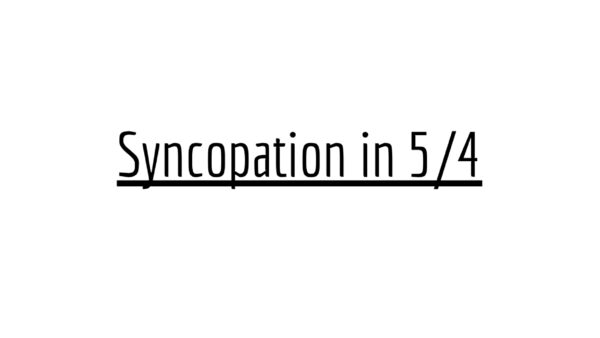
0. Standard Jazz time:
This is your baseline and the foundation every exercise builds from. Play standard jazz time on the ride cymbal (right hand) in 5/4. No hi-hat, snare or bass drum yet, only pure, clean timekeeping.

1. Play the melody on the Hi-Hat:
In this introductory exercise, the hi-hat (left foot) plays the full syncopated line. The right hand keeps standard 5/4 jazz time on the cymbal. If possible, try to feather the bass drum lightly on quarter notes and add a snare rim-click on beats 2 and 4.
Playing this exercise over all eight pages of the syncopation melodies trains essential hi-hat foot melody phrasing and independence with ride cymbal stability.
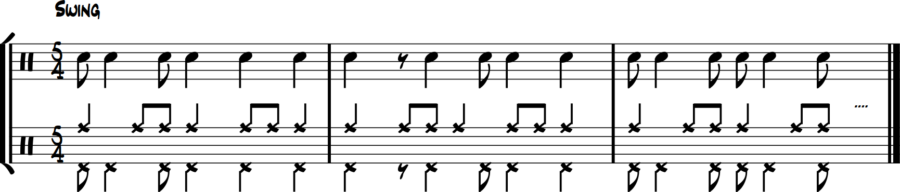
2. Short notes on Snare – Long notes on Hi-Hat:
In this exercise, the snare drum (left hand) and hi-hat (left foot) converse with each other. The snare plays all short notes (eighths), and the hi-hat plays all the notes longer than eighths. The right hand keeps steady 5/4 jazz time on the ride cymbal. If possible, try to feather the bass drum lightly on quarter notes.
Playing this exercise over all eight pages of the syncopation melodies trains a contrast dialogue between snare and hi-hat, developing touch variation and balanced phrasing texture.
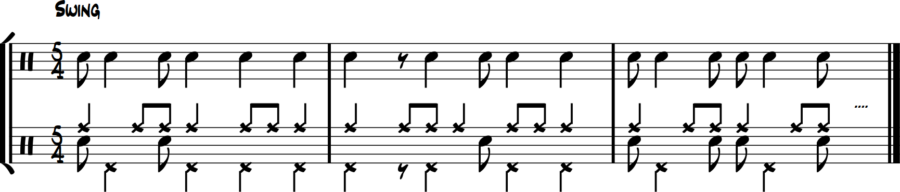
3. Short notes on Hi-Hat – Long notes on Snare:
This is the reverse of the previous exercise. The hi-hat (left foot) plays all the short notes (eighths), while the snare drum (left hand) plays all longer notes than eighths. The right hand continues to keep solid 5/4 jazz time. Also here, try to feather the bass drum lightly on quarter notes.
Playing this exercise over all eight pages of the syncopation melodies trains a reversed contrast dialogue between snare and hi-hat, enhancing limb adaptability and solid time continuity.
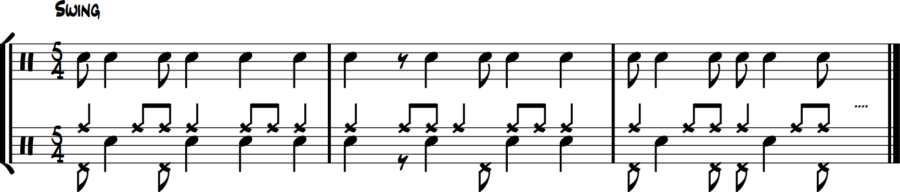
4. Short notes on Bass – Long notes on Hi-Hat:
In this exercise, the bass drum (right foot) and hi-hat (left foot) converse with each other. The bass drum plays all short notes (eighth notes), and the hi-hat plays all the notes longer than eighths. The right hand keeps steady 5/4 jazz time on the ride cymbal. If possible try to add a snare rim-click on beats 2 and 4.
Playing this exercise over all eight pages of the syncopation melodies trains a bass drum and hi-hat conversation, fostering pedal independence and a full pocket comping workout.
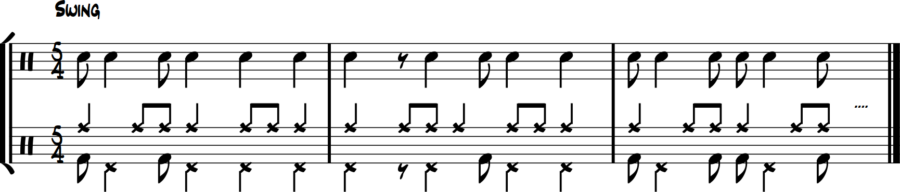
5. Short notes on Hi-Hat – Long notes on Bass:
This is the reverse of the previous exercise. The hi-hat (left foot) plays all the short notes (eighths), while the bass drum (right foot) plays all longer notes than eighths. The right hand continues to keep solid 5/4 jazz time. Also here try to add a snare rim-click on beats 2 and 4.
Playing this exercise over all eight pages of the syncopation melodies trains a reversed bass drum and hi-hat conversation, refining foot control for dynamic note lengths in a steady 5/4 jazz time.
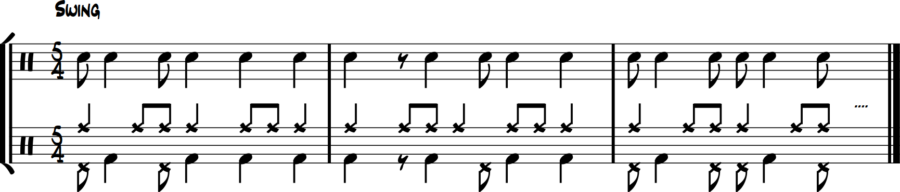
6. Snare drum plays melody – Hi-Hat fills in 8th notes:
In this exercise, the snare drum (left hand) plays the full syncopated line, while the hi-hat (left foot) fills in every eighth-note space between melody notes. The ride cymbal remains steady on the cymbal. If possible try to feather the bass drum lightly on quarter notes.
Playing this exercise over all eight pages of the syncopation melodies trains a snare melody with hi-hat fill ins, ultimately working towards voice leading and supportive melodic flow in 5/4.
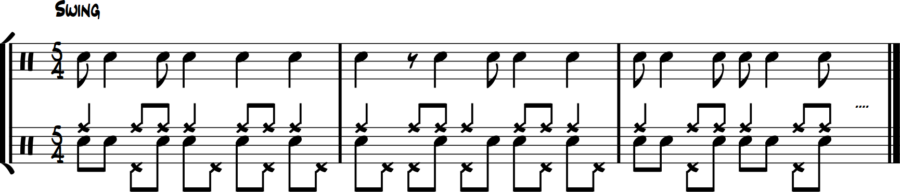
7. Hi-Hat plays the melody – Snare drum fills in 8th notes:
This exercise is the reverse of the previous exercise. The hi-hat (left foot) plays the full syncopated line, while the snare (left hand) fills in every eighth-note space between melody notes. The right hand keeps steady 5/4 swing time on the cymbal. If possible try to feather the bass drum lightly on quarter notes.
Playing this exercise over all eight pages of the syncopation melodies trains a hi-hat melody with snare fill ins, working towards inverted phrasing balance.
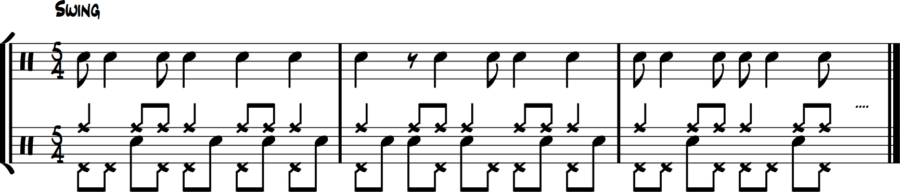
8. Bass drum plays the melody – Hi-hat fills in 8th notes:
In this exercise, the bass drum (right foot) plays the full syncopated line, while the hi-hat (left foot) fills in every eighth-note space between melody notes. The ride cymbal remains steady. Try to add a snare rim-click on beats 2 and 4.
Playing this exercise over all eight pages of the syncopation melodies trains a bass drum melody with hi-hat fill-ins, strengthening low-end syncopation and overall jazz time feel.
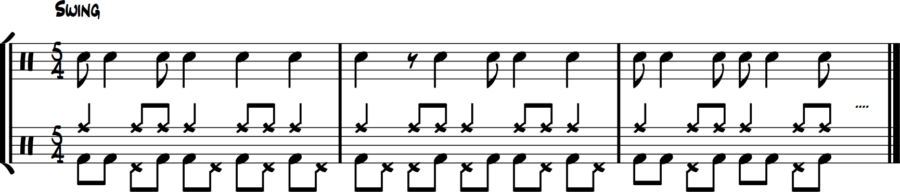
9. Hi-Hat plays the melody – Bass drum fills in 8th notes:
This exercise is the reverse of the previous exercise. The hi-hat (left foot) plays the full syncopated line, while the bass (right foot) fills in every eighth-note space between melody notes. The right hand keeps steady 5/4 swing time on the cymbal. Try to add a snare rim-click on beats 2 and 4.
Playing this exercise over all eight pages of the syncopation melodies trains a hi-hat melody with bass drum fill ins, working towards advancing limb independence swing coordination.
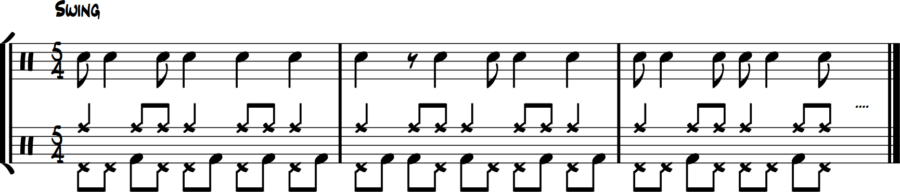
10. 8ths on Hi-Hat, Snare: short & Bass: long:
In this exercise, the snare drum (left hand) and Bass drum (Right Foot) converse with each other. The snare plays all the short notes (eighths) and the bass drum plays all the notes longer than eighths. The hi-hat (left foot) fills in every eight-note space between melody notes. The right hand keeps steady 5/4 jazz time on the ride cymbal.
Playing this exercise over all eight pages of the syncopation melodies trains four-limb independence through hi-hat fills and snare-bass voice layering.
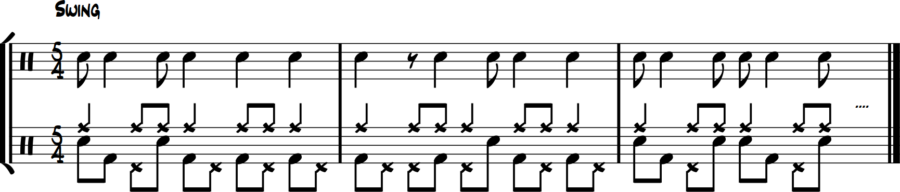
11. 8ths on Hi-Hat, Snare: long & bass: short:
This is the reverse of the previous exercise. The bass drum (right foot) plays all the short notes (eighths), while the snare drum (left hand) plays all longer notes than eighths. The hi-hat (left foot) fills in every eight-note space between the melody notes. The right hand continues to keep solid 5/4 jazz time.
Playing this exercise over all eight pages of the syncopation melodies trains textural reversal control and adaptive phrasing flexibility.
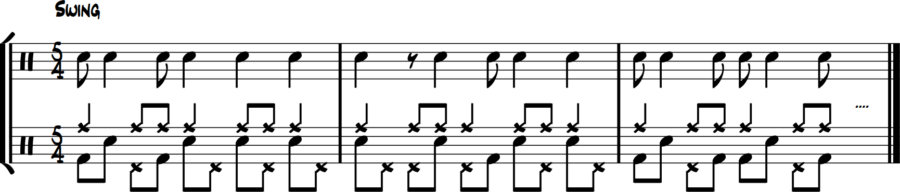
12. 8ths on the bass, Snare: Short & Hi-Hat: Long:
In this exercise, the snare drum (left hand) and hi-hat (left foot) converse with each other. The snare plays all the short notes (eighths) and the hi-hat plays all the notes longer than eighths. The bass drum (right foot) fills in every eight-note space between melody notes. The right hand keeps steady 5/4 jazz time on the ride cymbal.
Playing this exercise over all eight pages of the syncopation melodies trains bass drum fluency in supporting snare drum and hi-hat conversational dynamics.
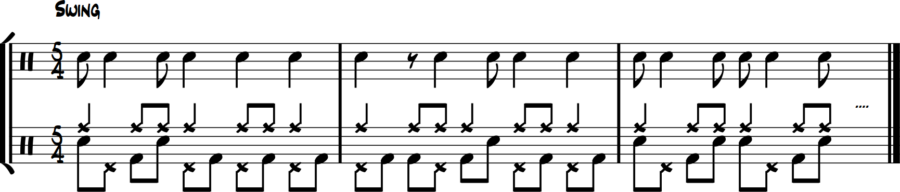
13. 8ths on the bass, Snare: Long & Hi-Hat: short:
This is the reverse of the previous exercise. The hi-hat (left foot) plays all the short notes (eighths), while the snare drum (left hand) plays all longer notes than eighths. The bass drum (right foot) fills in every eight-note space between the melody notes. The right hand continues to keep solid 5/4 jazz time.
Playing this exercise over all eight pages of the syncopation melodies trains limb control adaptability for increased groove density and balance.
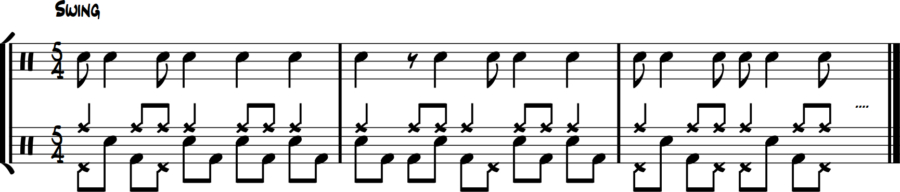
14. 8ths on the snare, Bass: short & Hi-Hat: long:
In this exercise, the bass drum (right foot) and hi-hat (left foot) converse with each other. The bass plays all the short notes (eighths) and the hi-hat plays all the notes longer than eighths. The snare drum (left hand) fills in every eight-note space between melody notes. The right hand keeps steady 5/4 jazz time on the ride cymbal.
Playing this exercise over all eight pages of the syncopation melodies trains background texture support in a consistent forward momentum.
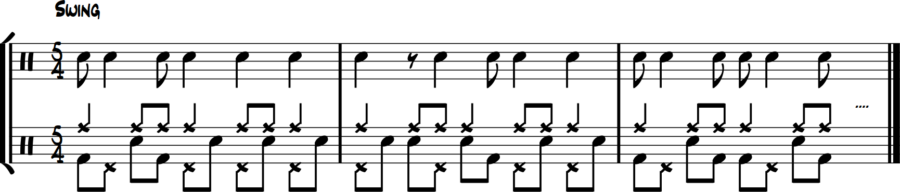
15. 8ths on the snare, Bass: long & Hi-Hat: short:
This is the reverse of the previous exercise. The hi-hat (left foot) plays all the short notes (eighths), while the bass drum (right foot) plays all longer notes than eighths. The snare drum (left hand) fills in every eight-note space between the melody notes. The right hand continues to keep solid 5/4 jazz time.
Playing this exercise over all eight pages of the syncopation melodies trains role-specific comping with precise touch and balance variation.
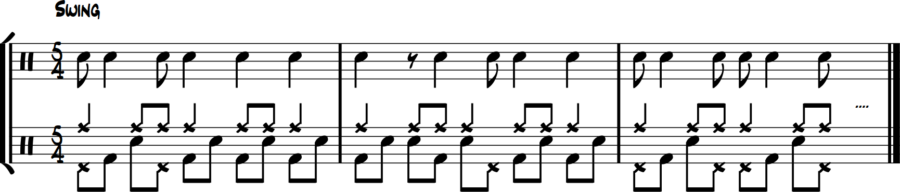
16. Snare plays melody & Hi-Hat fills in triplets:
In this exercise, the snare drum (left hand) plays the full syncopated line, while the hi-hat (left foot) fills every empty eighth-note triplet space between melody notes. The ride cymbal maintains a steady swing feel. If possible, try to feather the bass drum lightly on quarter notes.
Playing this exercise over all eight pages of the syncopation melodies trains triplet subdivision for deeper swing feel and phrasing nuances.
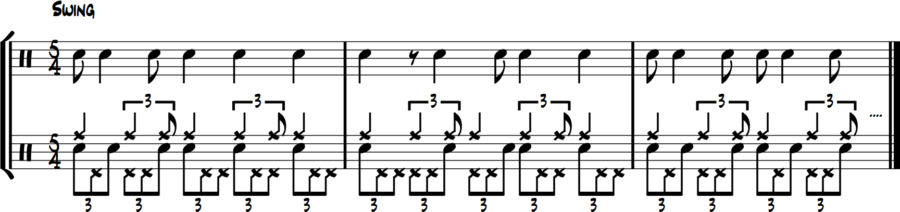
17. Hi-hat plays melody & snare fills in triplets:
In this version, the hi-hat (left foot) plays the complete syncopated line, while the snare drum (left hand) fills every empty triplet space. The ride cymbal keeps the swing feel consistent. If possible, try to feather the bass drum lightly on quarter notes.
Playing this exercise over all eight pages of the syncopation melodies trains rolling pocket texture via melodic independence on hi-hat.
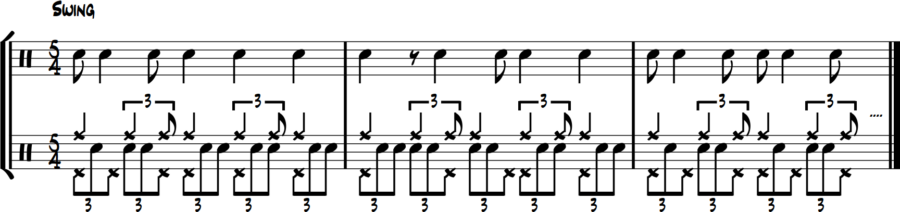
18. Bass plays the melody & Hi-Hat fills in triplets:
In this exercise, the bass drum (right foot) plays the full syncopated line, while the hi-hat (left foot) fills every empty eighth-note triplet space between melody notes. The ride cymbal maintains a steady swing feel. Try to add a snare rim-click on beats 2 and 4.
Playing this exercise over all eight pages of the syncopation melodies trains low-end phrasing power within controlled triplet grid fills.
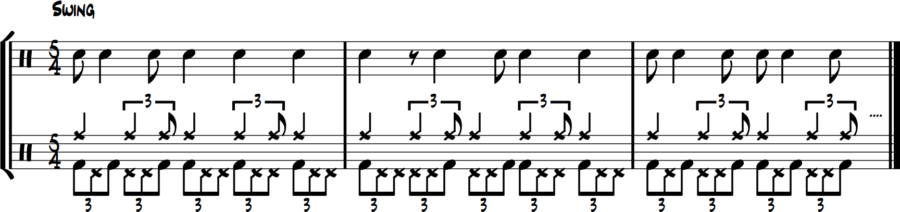
19. Hi-Hat plays the melody & bass fills in Triplets:
In this version, the hi-hat (left foot) plays the complete syncopated line, while the bass drum (right foot) fills every empty triplet space. The ride cymbal keeps the swing feel consistent. Try to add a snare rim-click on beats 2 and 4.
Playing this exercise over all eight pages of the syncopation melodies trains triplet voice balance and advanced foot coordination, overall improving bass phrasing power.
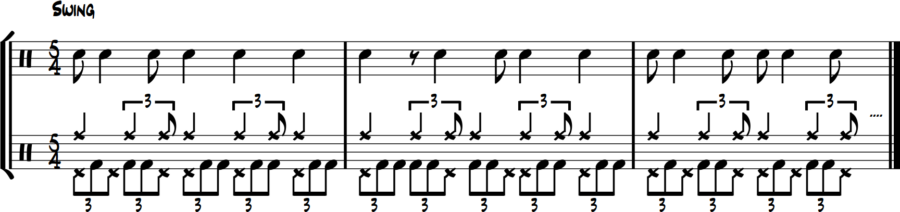
20. Triplets on Hi-Hat, Snare: short & bass: long:
In this exercise, the snare drum (left hand) and bass drum (right foot) converse with each other. The snare plays all the short notes (eighths) and the bass drum plays all the notes longer than eighths. The hi-hat (left foot) fills in every triplet space between melody notes. The right hand keeps steady 5/4 jazz time on the ride cymbal.
Playing this exercise over all eight pages of the syncopation melodies trains layering triplets over short/long splits for superior textural balance.
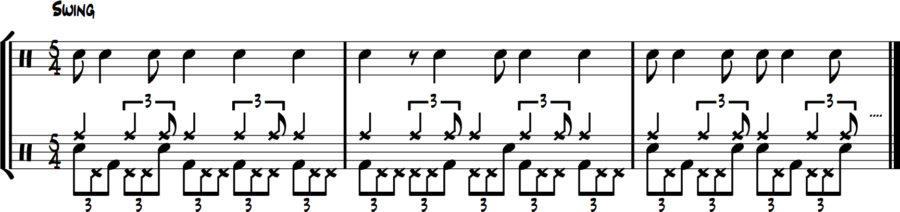
21. Triplets on Hi-Hat, Bass: short & Snare: long:
This is the reverse of the previous exercise. The bass drum (right foot) plays all the short notes (eighths), while the snare drum (left hand) plays all longer notes than eighths. The hi-hat (left foot) fills in every triplet space between the melody notes. The right hand continues to keep solid 5/4 jazz time.
Playing this exercise over all eight pages of the syncopation melodies trains independence through reversal and pocket stability.
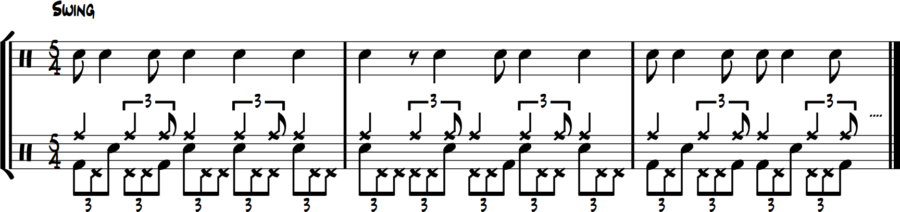
22. Triplets on Bass, Snare: Short & Hi-Hat: Long:
In this exercise, the snare drum (left hand) and hi-hat (left foot) converse with each other. The snare plays all the short notes (eighths) and the hi-hat plays all the notes longer than eighths. The bass drum fills in every triplet space between melody notes. The right hand keeps steady 5/4 jazz time on the ride cymbal.
Playing this exercise over all eight pages of the syncopation melodies trains bass creativity in multi-limb dialogue fluency.
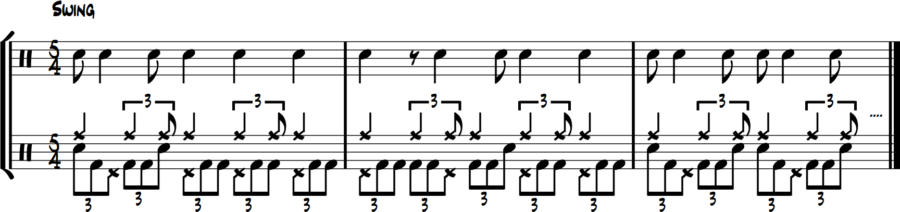
23. Triplets on Bass, hi-Hat: Short & Snare: Long:
This is the reverse of the previous exercise. The hi-hat (left foot) plays all the short notes (eighths), while the snare drum (left hand) plays all longer notes than eighths. The bass drum (right foot) fills in every triplet space between the melody notes. The right hand continues to keep solid 5/4 jazz time.
Playing this exercise over all eight pages of the syncopation melodies trains seamless triplet phrasing and full four-limb integration.
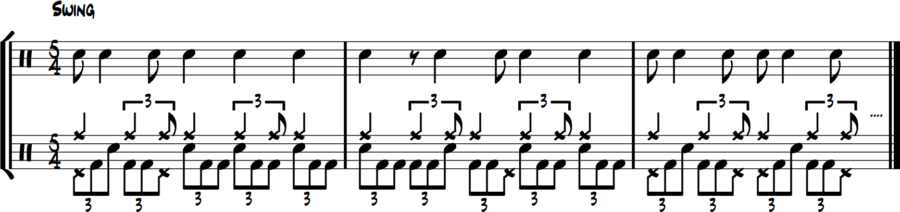
24. Triplets on Snare, Bass: Short & Hi-Hat: Long:
In this exercise, the bass drum (right foot) and hi-hat (left foot) converse with each other. The bass plays all the short notes (eighths) and the hi-hat plays all the notes longer than eighths. The snare drum (left hand) fills in every triplet space between melody notes. The right hand keeps steady 5/4 jazz time on the ride cymbal.
Playing this exercise over all eight pages of the syncopation melodies trains a supportive rolling foundation with dynamic touch variation.
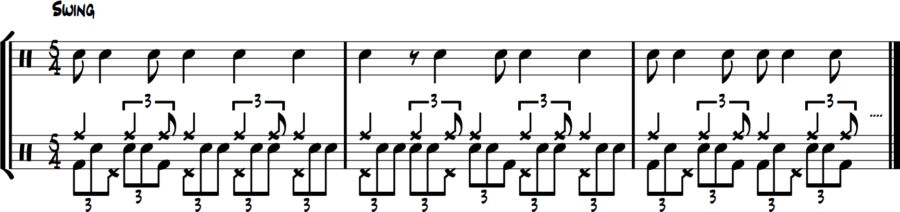
25. Triplets on Snare, Hi-Hat: Short & Bass: Long:
This is the reverse of the previous exercise. The hi-hat (left foot) plays all the short notes (eighths), while the bass drum (right foot) plays all longer notes than eighths. The snare drum (left hand) fills in every triplet space between the melody notes. The right hand continues to keep solid 5/4 jazz time.
Playing this exercise over all eight pages of the syncopation melodies trains ultimate four-way independence and pro-level comping fluency.
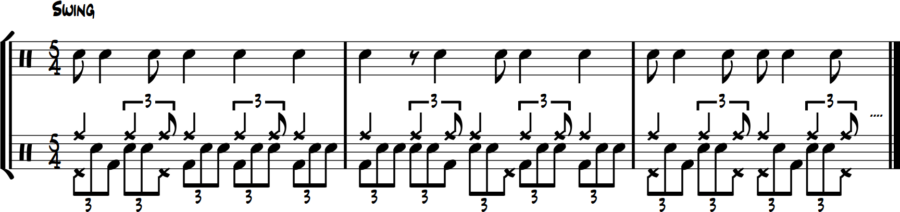
The printable PDF course:
Are you ready for more?
If you’re ready to take it a step further, make sure to check out my lessons on 25 four-limb Syncopation exercises in other time signatures like 3/4 or back to 4/4. These exercises offer a collection of brand‑new comping ideas and variations that push coordination and phrasing even deeper.
While you’re here, feel free to explore my growing library of drum transcriptions or other music downloads. All these downloads are designed to help you level up your creativity and overall musicianship. Thank you for reading this post and if it helped you, feel free to share it with other drummers. Let’s keep the groove alive and keep learning together.
Are you enjoying following our Music sections? Please let us know in the comments below! If you’d like to learn more about Yentl’s life as a musician, explore the Projects page for current collaborations or visit Online Education for drum lessons and creative inspiration.
To stay up to date with upcoming music posts, performances, and behind‑the‑scenes stories, follow us on Facebook or check this website regularly. We can’t build this platform without our readers, so thank you for your continued support. Stay tuned for plenty more music and stories to come!