
The Ultimate Guide to Paradiddles (with Permarhythms)
Have you ever felt like you “know” your paradiddles, but they still don’t really show up in your playing the way you want? You can play RLRR LRLL on a practice pad all day, but when you sit behind the kit, your hands fall back into the same old patterns.
This post is here to change that. In this guide, I’ll show you what paradiddles are, why they are worth serious practice time, and how my unique Permarhythms system gives you a structured way to practise every paradiddle‑type combination. Along the way, you’ll get a clear explanation of how to turn simple permutations into powerful paradiddle workouts and how to use them in real grooves and fills.
If you already know you want a guided path (with all permutations laid out, step‑by‑step training and stickings clearly written in PDF format), check out the Permarhythms Paradiddle Course. It expands everything in this post into a complete practice system for groupings in 3, 4, 5 and 6, with structured routines and printable exercises you can follow week by week.
The Paradiddle Course will be available from 29th of April 2026.
1. What is a paradiddle?
A paradiddle is one of the essential drum rudiments. It’s built from a mix of single strokes and double strokes in a four‑note cell. The classic single paradiddle is:
R L R R | L R L L
or mirrored as:
If you say “pa‑ra‑did‑dle” out loud while you play it, the “pa‑ra” syllables line up with the single strokes and “did‑dle” with the double strokes. That simple combination of singles and doubles is why paradiddles are so useful: they give you built‑in speed, flow, and direction changes without having to think about complex patterns.

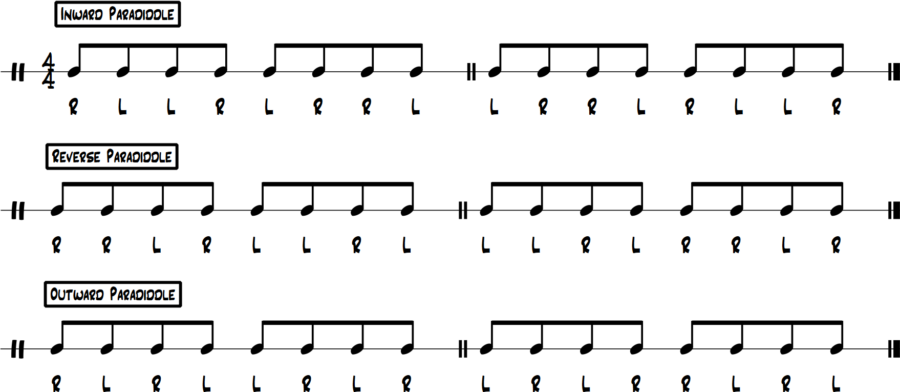
On top of the basic paradiddle, there are also inversion variations created by shifting where the double stroke falls. Depending on the naming system you use, these are often called:
- Inward paradiddle (R L L R | L R R L)
- Reverse paradiddle (R R L R | L L R L)
- Outward paradiddle (R L R L | L R L R)
All of them are still only combinations of singles and doubles, but the accent and feel change completely.
Beyond single paradiddles, rudimental literature also recognises double paradiddles, triple paradiddles, and paradiddle‑diddles, which extend the pattern by adding more single strokes before or after the double strokes.
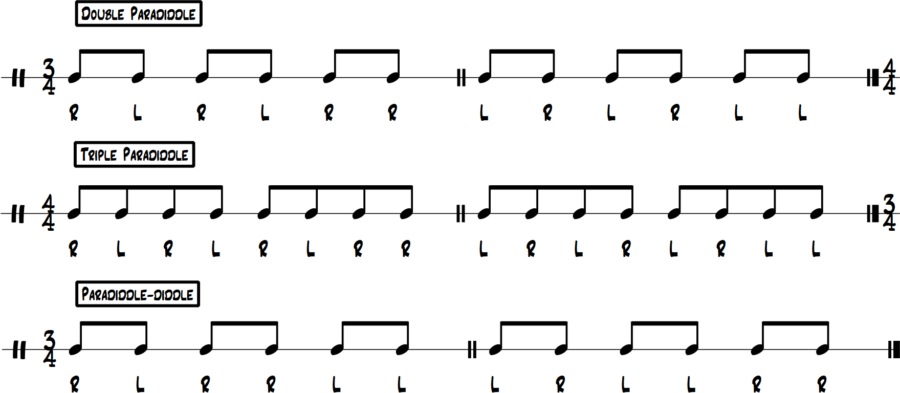
2. Why paradiddles are worth your practice time:
So why do almost every teacher and every drum course keep coming back to paradiddles? Easy answer: because a single paradiddle trains a lot in one go:
- Hand technique and control: Mixing singles and doubles forces you to develop smooth transition between wrist strokes and diddles, which boosts your roll speed and endurance.
- Dynamics and accents: By shifting accents around within the paradiddle, you learn to control ghost notes versus loud notes—perfect for groove nuance and phrasing.
- Coordination and independence: Once you add feet, paradiddles become a fantastic tool for four‑way independence and limb balance in almost any style.
- Real musical vocabulary: Paradiddles sit inside countless fills, linear phrases, chop patterns and even simple grooves across rock, jazz, funk, metal and more.
In other words: if your paradiddles are solid, everything on the kit feels easier.
3. The limits of traditional paradiddle exercises:
Most paradiddle practice routines look something like this:
- Play RLRR LRLL as 8ths or 16ths on a pad.
- Learn the four famous inversions.
- Add a few accent patterns.
- Move the hands around the kit.
This absolutely works but it leaves a lot of potential on the table:
- You usually end up repeating the same handful of paradiddle variations.
- Many possible combinations of singles and doubles never get practised.
- It’s hard to know if you’ve really “covered” paradiddles in different time signatures and contexts.
- For non‑readers, pages packed with notation can be overwhelming, especially once odd meters and displacements enter the picture.
That’s why I started working with permutations: instead of a few favourite patterns, I wanted a way to systematically move through all useful combinations and to do it in a visually simple way.
4. What is Permarhythms?
Permarhythms grew out of the system I first published as my Rhythmic Permutations eBook.
Instead of traditional notation, the book uses white and black dots:
- White dots = positions in the rhythmic grid.
- Black dots = rhythm placements within that grid.
For a 3‑dot system, for example, you get:
- Three single‑dot combinations (1, 2, 3).
- Three double‑dot combinations (1‑2, 1‑3, 2‑3).
- One all‑dots‑filled state (1‑2‑3).
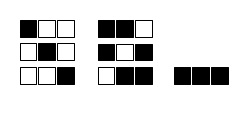
The key advantages:
- Notation‑free: You don’t need to read traditional notation to start using the system.
- Flexible: The same dot line can be treated as 8ths, 16ths, triplets, etc., depending on the context.
- Complete: Within each grouping, you know you’ve hit every possible combination of “on” and “off” positions.
In this post, we’ll use that same idea but map the dots to singles and doubles, turning them into paradiddle‑type stickings.
5. How Permarhythms turns dots into paradiddles:
To keep things clear we start with the 3‑dot system. Once you understand it here, the logic is identical for the other systems.
Step 1: The 3-dot permutations:
In the 3‑dot system, each position can be either “on” (blacked‑out) or “off” (open). For three positions, that gives you:
- Three one‑dot combinations
- Only 1 is blacked.
- Only 2 is blacked.
- Only 3 is blacked.
- Three two‑dot combinations
- 1 and 2 are blacked.
- 1 and 3 are blacked.
- 2 and 3 are blacked.
(There is also the all‑three‑black combination, but for paradiddle practice we don’t use that one)
Step 2 : Mapping dots to single and double strokes:
For this paradiddle workout, we’ll use the following rule:
- Blacked‑out = two single strokes (RL or LR)
- Open = double stroke (RR or LL)
We also want the pattern to loop well, so we choose stickings that bring us back into a natural starting hand when we repeat.
Step 3: Concrete examples with the 3-dot permutations:
- Example 1 – Only position 1 is blacked (2 & 3 open)

Mapping:
- Position 1 (black) → RL
- Position 2 (open) → RR
- Position 3 (open) → LL

You end on LL, so for the repeat you naturally come back to R to keep the pattern flowing. Now you’re playing a six‑stroke phrase that alternates between singles and doubles in a paradiddle way, but derived directly from the dot pattern.
- Example 2 – Positions 1 and 2 blacked (3 open)

Mapping:
- 1 (black) → RL
- 2 (black) → RL
- 3 (open) → RR

You end on RR, so for the repeat you naturally come back to L to keep the pattern flowing.
Step 4: Flipping the system:
Up to now black = singles and open = doubles. But you can flip that:
- Blacked‑out = double (RR or LL)
- Open = two singles (RL or LR)
If you run the same 3‑dot permutations through this inverted mapping, you instantly generate a second whole family of paradiddle‑type patterns. This is one of the reasons Permarhythms is so powerful: one permutation page can fuel multiple workouts, just by changing how you interpret the dots.
6. Paradiddle permutations in 3, 4, 5 and 6:
Now that the mapping is clear in 3, let’s zoom out and see how this applies across different groupings and meters.
Grouping 3: 16ths in 3/8 → 6/8 or 8ths in 3/4
In a 3‑dot system, each dot can represent a 16th‑note position in 3/8. When you loop your paradiddle‑type phrase, it naturally turns around across the barline, so over time you’re effectively practising over a full 6/8 cycle. Likewise, the 3-dot system represents 8th-note positions in 3/4, making it a useful tool for both simple and compound meters.
Grouping 4: 16ths or 8ths in 2/4 → 4/4
The 4-dot system is the closest to the traditional paradiddle context: 4‑note cells in straight 4/4, but now generated systematically from permutations instead of just the four classic single‑paradiddle inversions.
Grouping 5: 5/8 and 5/4
In the 5‑dot system, each pattern can be interpreted as a 5/8 phrase or a 5/4 bar.
Grouping 6 – 6/8 and 12/8
The 6‑dot system can be used as 16th notes in 6/8 and gets further into 12/8 as the exercise is repeated. These groupings also work well with sixtuplets in 4/4.
7. Making paradiddles sound good:
All the exercise above are only useful if they show up in your playing. Here are a few basic ideas to bridge the gap:
- Turn permutations into grooves:
Choose a paradiddle‑type pattern, accent notes that fall on your backbeats, and let the other strokes become ghost notes. Now you’re building a real groove out of a “technical” pattern. - Use them as fills:
Take the same pattern and orchestrate it around the toms and cymbals, keeping doubles on the snare or on one surface. Think in phrases of one or two bars leading into a backbeat. - Displace the pattern:
Start the permutation one 16th later, or one 8th later, and feel how the accents and phrase shape change without touching the sticking itself. This is a great way to explore syncopation and displacement.
8. The Permarhythms Paradiddle Course
This post gives you the core idea and enough exercises to keep you busy for a while. But if you want a complete, step‑by‑step path through all the useful paradiddle permutations in 3, 4, 5 and 6, that’s exactly what the Permarhythms Paradiddle Course is for.
Inside the course, you’ll find:
- A structured PDF workbook with the key permutations for each grouping.
- Practice plans with suggested tempos and progressions (e.g. “Week 1: 3‑dot permutations in 6/8”, “Week 2: 4‑dot permutations in 4/4”, etc.).
- Examples of how to turn these patterns into grooves and fills in different styles.
Think of this blog post as a quick overview and the course as the complete training program that compresses years of trial‑and‑error into a clear, logical system.
The Paradiddle Course will be available from 29th of April 2026.
9. FAQ
- Do I need to read drum notation to use this system? No. The whole idea of Permarhythms is that you can start with dots and stickings. If you do read music, you can absolutely notate everything later, but it’s not required.
- Is this suitable for beginners? If you can play single strokes, double strokes, and a basic paradiddle, you can start with the easier permutations and slower tempos. Total beginners should first learn basic stick control and the single paradiddle before diving into the full system.
- What gear do I need? A simple practice pad or snare drum, a metronome, and any drum kit are enough. You can do most of the core work on a pad and then apply it to the kit when you’re ready.
- How long should I practise paradiddles each day? As always, consistency beats intensity. Around 5 minutes per day focused on paradiddles (as part of your warm‑up or main routine) will give you better results than one huge session once a week.
Are you enjoying following our Music sections? Please let us know in the comments below! If you’d like to learn more about Yentl’s life as a musician, explore the Projects page for current collaborations or visit Online Education for drum lessons and creative inspiration.
To stay up to date with upcoming music posts, performances, and behind‑the‑scenes stories, follow us on Facebook or check this website regularly. We can’t build this platform without our readers, so thank you for your continued support. Stay tuned for plenty more music and stories to come!