
Jazz-drum independence exercises for beginners (3 drum lessons) | PDF download
Independence on the drum set, or the commonly used term limb independence, describes the coordination ability necessary for multitasking behind the drum kit. Pretty much all drummers use their four limbs whenever they play the drums. This ability allows them to move freely around the drum kit and respond to various factors within the music they are playing. The drum independence exercises for beginners start from a basic or fundamental groove. From there, they focus on one particular limb to train limb independence.
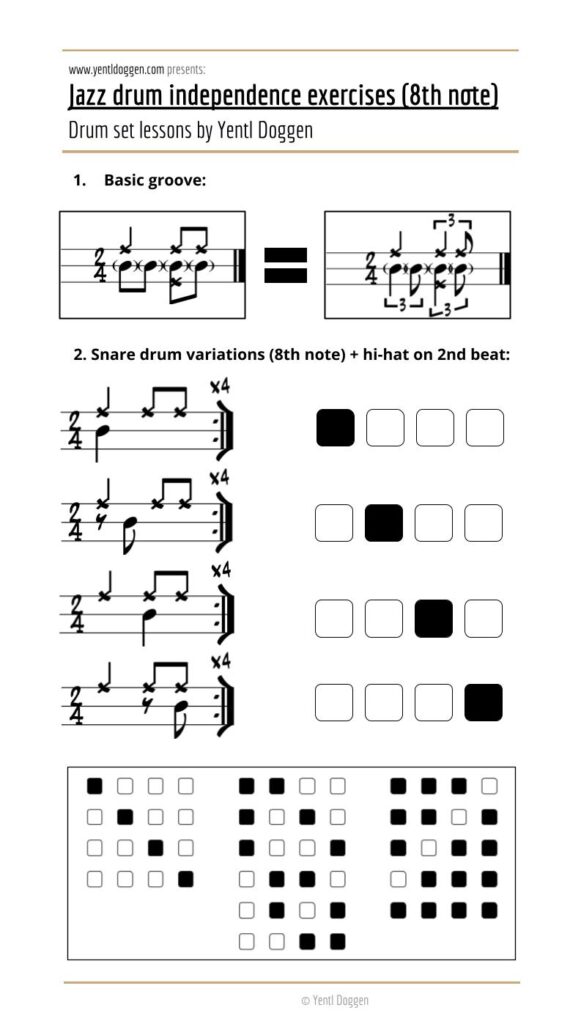
All following drum lessons consist of two different notations. The first notation is the classical drum notation. The second notation represents the accompanying permutational visualisation. Only the first four exercises are written in classical drum notation and give a basic introduction to the 15 different permutational options. I opt for learning these drum independence exercises by the permutations to make you play independently from the classical notation. Moreover, it is easier to visualise all possible combinations through these permutation tables than in the classical notation. This is especially true when the exercises start getting more complex.
How to practise these exercises?
For the best long-term results, I suggest practising with a metronome. I did not give any metronome marks as it doesn’t matter much how slow or fast you play these exercises. It is more critical that every pattern feels comfortable while playing it. Only when the movement feels right can we work on improving the speed. The tempo of the play-along track is 100 bpm. However, the pace is adjustable to your needs in most audio players. I suggest playing every practice at least four times before moving on to the next exercise. Correctly playing an exercise four times a row is a good sign that the activity is well understood.
The downloadable play-along track for these jazz-drum independence exercises for beginners has the following structure;
- Two bars as a countdown.
- Four times the basic or fundamental swing groove.
- All practices played four times.
1. Jazz-drum independence exercises – Snare drum (8th note).
The first drum lesson focuses on snare drum independence. Exercise one shows the fundamental swing groove we will use in this entire exercise. Although the notation is straight in the first cell and throughout the exercises, the practice should be played in a swing feel, as the second cell shows. The snare drum notes are between brackets, so this basic swing groove only consists of the ride-cymbal in the right hand and the hi-hat on the second beat in the left foot. The hi-hat is not notated in the second exercise but should be played consistently on the second beat.
In exercise two, we add the snare drum. The first snare drum comes together with the first ride-cymbal. After that, the snare drum moves to the second eight-note, which is technically the third triplet as this is played in a swing feel and moves to the third and fourth eight notes, going over all the single eight-note snare drum options. Exercise two shows two different notations. The image on the left represents the classical drum notation. The image on the right is for the accompanying permutational visualisation.
To finish this first drum lesson, we must complete the table at the end of the page according to the same principles above. Two black dots stand for two snare drums, and three black dots for three snare drums.
If this is your first attempt at playing the drums, these exercises might be tough to play. I would recommend starting with the following post to get more familiar with the drum set; How to play your first groove on the drumset. This drum lesson teaches you the basics of playing the perfect first groove on the drum set, including plenty of independence exercises.
2. Jazz-drum independence exercises – Bass drum (8th note).
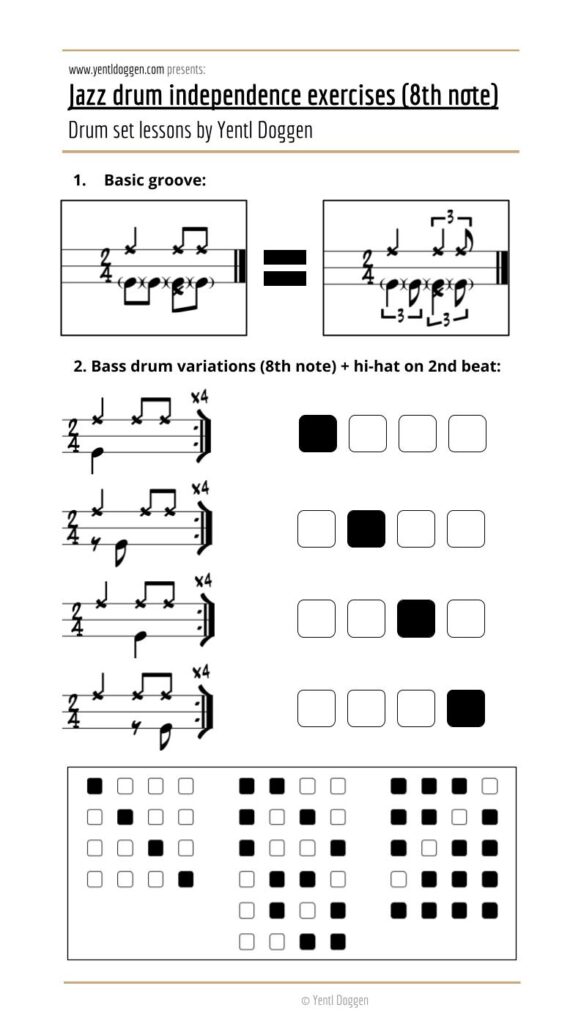
The second drum lesson focuses on bass drum independence. Exercise one shows the fundamental swing groove we will use in this entire exercise. Although the notation is straight in the first cell and throughout the exercises, the practice should be played in a swing feel, as the second cell shows. The bass drum notes are between brackets, so this basic swing groove only consists of the ride-cymbal in the right hand and the hi-hat on the second beat in the left foot. The hi-hat is not notated in the second exercise but should be played consistently on the second beat.
In exercise two, we add the bass drum. The first bass drum comes together with the first ride-cymbal. After that, the bass drum moves to the second eight-note, which is technically the third triplet as this is played in a swing feel and moves to the third and fourth eight notes, going over all the single eight-note bass drum options. Exercise two shows two different notations. The image on the left represents the classical drum notation. The image on the right is for the accompanying permutational visualisation.
To finish this first drum lesson, we must complete the table at the end of the page according to the same principles above. Two black dots stand for two bass drums, and three black dots for three bass drums.
You can download a larger version of the permutations table in the permutations: 4, 5 and 6 posts! It is helpful for this drum lesson and the other lessons in this post. Additionally, I recently published an eBook containing all rhythmic permutations up to the 12-beat variations: Ebook: Rhythmic Permutations, which will expand your rhythmical knowledge further!
3. Jazz-drum independence exercises – Hi-hat (8th note).
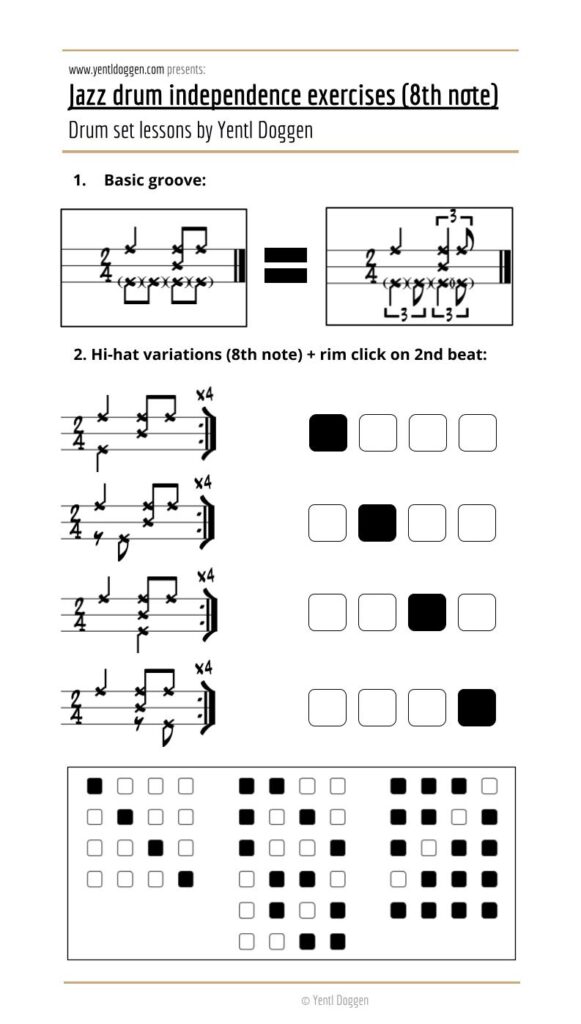
The third drum lesson focuses on hi-hat independence in the left foot. Exercise one shows the fundamental swing groove we will use in this entire exercise. Although the notation is straight in the first cell and throughout the exercises, the practice should be played in a swing feel, as the second cell shows. The hi-hat notes are between brackets, so this basic swing groove only consists of the ride-cymbal in the right hand and a snare drum rim click on the second beat in the left hand.
In exercise two, we add the hi-hat to the left foot. The first hi-hat comes together with the first ride-cymbal. After that, the hi-hat moves to the second eight-note, which is technically the third triplet as this is played in a swing feel and moves to the third and fourth eight notes, going over all the single eight-note hi-hat options. Exercise two shows two different notations. The image on the left represents the classical drum notation. The image on the right is for the accompanying permutational visualisation.
To finish this first drum lesson, we must complete the table at the end of the page according to the same principles above. Two black dots stand for two hi-hats, and three black dots for three hi-hats.
Are you finished with these drum lessons? Take a look at the next available course. The drum lessons and exercise section is full of practices to improve your skills on the drum set! 🙂
Are you enjoying following our Music sections? Please let us know in the comments below! If you’d like to learn more about Yentl’s life as a musician, explore the Projects page for current collaborations or visit Online Education for drum lessons and creative inspiration.
To stay up to date with upcoming music posts, performances, and behind‑the‑scenes stories, follow us on Facebook or check this website regularly. We can’t build this platform without our readers, so thank you for your continued support. Stay tuned for plenty more music and stories to come!