
Jordu – Max Roach – Drum Transcription
In 2017, I finished two university degrees at the Luca School Of Arts in Leuven, Belgium. My first degree is a master’s degree in drums and percussion. The second degree is a bachelor’s in jazz studies. As part of graduating in jazz, I researched the link between four Max Roach drum solos and their jazz standard’s melody. I wrote the initial document in Dutch, although over time, I converted it to English. Here you can download the (free) PDF for the drum transcription of Jordu, one of the Max Roach drum solos I analysed. Below that, this post includes a brief analysis of the drum solo. If you have any questions, send a message on the contact page or leave a comment!
Analysis of the Jordu drum transcription by Max Roach:
Jordu was written by Irving “Duke” Jordan in 1953 and made famous by the Capitol recording of the 1954 album Clifford Brown & Max Roach. Earlier, Duke Jordan had recorded Jordu under the original name Minor Escamp. However, the name Jordu is an anagram of the author’s name. Personnel on the Clifford Brown (trumpet) and Max Roach (drummer) album are Harold Land on tenor saxophone, Richie Powell on piano, and George Morrow on double bass. The recording of Jordu and the album itself are typical of the band’s hard bop music style. In addition, the album is famous as one of the strongest studio albums up to that time (Ben Ratliff, New York Times). The standard became regularly played, as well as Daahoud and Joy Spring from the same album and Sandu.
Additionally, Karrin Allyson wrote lyrics for Jordu on the song Life Is a Groove. This version was released in 2006 on Footprints in duo form with Nancy King.
Macroscopic analysis of Jordu:
Max Roach’s drum solo on Jordu mainly consists of two-measure patterns. Although the structure shows clearly in several places, there are also places where Max draws his designs over the general form. One reason for this may be that the melody primarily consists of upbeats. The first part of the solo is primarily characterised by the use of sixteenth notes, while the second part mainly contains triplets. It is striking that less attention goes to the melody here, and Max primarily plays with the patterns he created during the solo.
Microscopic analysis (first 3 bars):
Although there is no direct link to the melody, the first three bars are worth mentioning. Max Roach wraps the chromatic descending line in the first measure into a syncopated pattern. Starting on the floor tom and continuing to the highest tom, he creates a question. He answers this question in the third bar by starting again on the floor tom and ending on the snare drum. The snare drum exactly overlaps with the last note in the melody of this measure. Max Roach generates on the drum kit the same feeling that the melody generates.
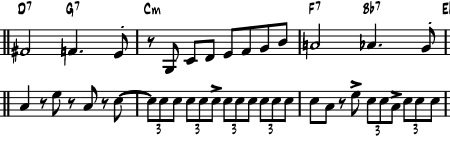
Moreover, the first bar is followed by playing triplets in a continuous motion in the second measure. The same movement that we find in the eighth notes of the melody. In the third measure, the first measure returns a minor third higher. The mindset and how he played the first measure are reused here, not in the same form, but in a more crowded rhythm. The floor tom has moved to the 1+, the same place as where the rhythm section places its accent. The placement of the high and floor toms has remained the same and is enriched with an accent. The snare is only used to fill up the gaps.
Microscopic analysis (bars 5 and 6):
Max Roach plays again with the rhythmic figure in bar five as he did in the first three bars. Here too, the placement of the rhythm partly corresponds to that of the melody. Starting on the last sixteenth of the first beat, we get a rhythmic figure that tends to emphasise the 1 +, after which the snare drum overlaps with the third beat. We get the floor tom just after the last melody note in this measure. The placement of this is a logical consequence of the pattern per three-sixteenths that is continued here.

Melodically, just like in the melody, the drum solo is played from high to low. In the following bar, Max Roach does the opposite as an answer to the first pattern. Starting on the high tom, he uses the snare drum to make his way to the floor tom. He goes through the snare drum back to the high tom. Finally, this ends with an accented snare drum on the 4+, which coincides with the syncopated melody note.
Microscopic analysis (bar 27, 28 and 29):
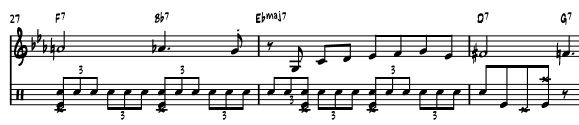
As previously mentioned, the drum solo in Jordu uses less material that has a direct link to the melody. To close this analysis, we will look at bars 27 and 28. Max Roach plays a continuous snare drum pattern here and provides accents on the cymbal along with the bass drum. In bar 27, we see a clear connection between the melody and the placement of the accents. These accents overlap both on the first and the third beat. Max Roach’s way of thinking is confirmed in the 28th bar. The same accent is placed on the 1 +, where the upbeat to the next bar starts. Furthermore, he also gives the third beat, which could be a different reference to the syncopated rhythm on the last third beat of the measure. The triplet pattern ends with a snare drum beat followed by a bass drum.
Are you enjoying following our Music sections? Please let us know in the comments below! If you’d like to learn more about Yentl’s life as a musician, explore the Projects page for current collaborations or visit Online Education for drum lessons and creative inspiration.
To stay up to date with upcoming music posts, performances, and behind‑the‑scenes stories, follow us on Facebook or check this website regularly. We can’t build this platform without our readers, so thank you for your continued support. Stay tuned for plenty more music and stories to come!