
10 Jazz Drum Comping Hacks (3/4) from Ted Reed’s Syncopation
If there’s one drum book that has quietly shaped generations of drummers, it’s Ted Reed’s Progressive Steps to Syncopation for the Modern Drummer. First published in 1958, this classic has become a universal language for drum teachers, students, and players worldwide. The book itself is simple on paper but incredibly deep in practice. Syncopation (as it’s commonly known) can train just about any rhythmic concept you can imagine. Moreover, every new interpretation opens up another corner of your drumming vocabulary. In fact, Modern Drummer ranked Syncopation second on its 1993 list of the 25 greatest drum books of all time.
In this drum-lesson, I’m sharing 10 Jazz Drum Comping Hacks (3/4) based directly on the eight full-page syncopation exercises from Reed’s book. As Progressive Steps to Syncopation for the Modern Drummer itself doesn’t include exercises in 3/4, I’ve carefully rewritten the existing exercises while maintaining the same style Ted Reed used. These exercises in 3/4 are practical, creative interpretations that turn simple reading lines into powerful coordination workouts for waltz jazz time and beyond. Each one of these exercises develops a different aspect of comping, from voice balance and phrasing contrast to triplet flow and swing feel.
If you’re new to reading drum set notation, make sure to first check out my guide on The Art of Reading Drum Sheet Music. This post (and its downloadable PDF) covers all the basics you’ll need to get the most out of these and future exercises.
How to practise these exercises:
Before you start, take a moment to set up a good workflow. A steady 80–90 BPM is a great spot if you’re already familiar with jazz coordination. If not, start a bit slower around 70 BPM. Most of these exercises will feel comfortable between 100–120 BPM.
In the beginning, focus on multiple single bars or short two‑bar phrases. Make them feel good before trying to play through an entire page. The goal isn’t to rush but it’s to make the music feel good. Concentrate on balance, touch, and making your groove swing naturally. Once these bars feel solid, connect a few at a time until the whole exercise flows evenly. The more attention you give to sound, motion, and feel, the faster your comping vocabulary will grow.
Ready to dive in? Download the full eight‑page exercise set in 3/4, follow along, and start turning these timeless reading lines into your own creative comping ideas.
0. Standard Jazz time:
This is your baseline and the foundation every exercise builds from. Play 3/4 jazz time on the ride cymbal (right hand) and a crisp hi-hat chick on 2 (left foot) for that locked-in backbeat feel. No snare or bass drum yet, only pure, clean waltz timekeeping.

1. Play the melody on the Snare Drum:
In this first exercise, the snare drum (left hand) plays the complete syncopated line. The right hand keeps standard 3/4 jazz time on the cymbal, while the hi-hat (left foot) closes lightly on beat 2. If possible, try to feather the bass drum lightly on the quarter notes.
Playing this over all eight pages of the 3/4 Syncopation melodies trains classic snare-focused melodic phrasing while maintaining solid 3/4 jazz time underneath.

2. Play the melody on the Bass Drum:
In this second exercise, the bass drum (right foot) plays the complete syncopated line. The right hand sustains steady 3/4 jazz time on the cymbal, while the hi-hat (left foot) maintains beat 2. Once you’re comfortable, try adding a rim-click on the snare drum (left hand) together with the hi-hat on 2.
Playing this over all eight pages of the 3/4 Syncopation melodies builds a strong comping foundation on the bass drum. This is essential for pocket, balance, and independence in a 3/4 groove.
3. Short Notes on Snare – Long Notes on Bass:
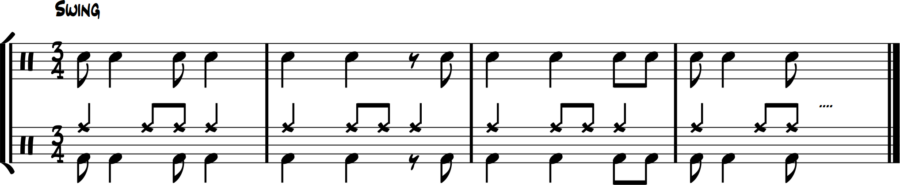
In this exercise, the snare drum (left hand) and bass drum (right foot) converse with each other. The snare plays all short notes (eighth notes), and the bass drum plays all notes longer than eighths. The right hand keeps steady 3/4 jazz time on the ride cymbal, while the hi-hat (left foot) stays on beat 2.
This exercise trains natural jazz phrasing contrast. The snare drum delivers syncopated attacks while the bass drum handles the longer displacements. It’s a great phrasing vocabulary exercise that balances commentary and timekeeping.
4. Long Notes on Snare – Short Notes on Bass:
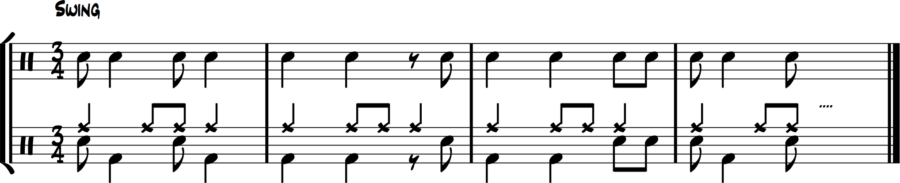
This is the reverse of the previous exercise. The bass drum (right foot) plays all the short notes (eighths), while the snare drum (left hand) plays all notes longer than eighths. The right hand and hi-hat continue to keep solid 3/4 jazz time.
This exercise trains reversed voicing textures. It requires the same coordination as exercise 3, but with a completely different musical 3/4 feel.
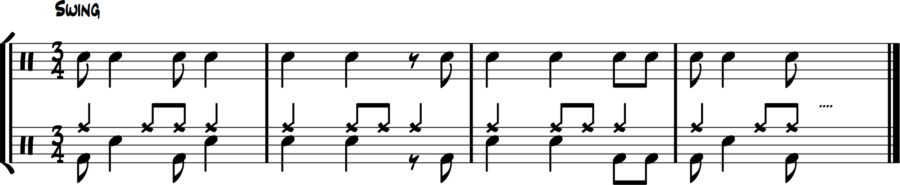
5. Alternate Snare and Bass Drum:
In this exercise, the snare drum (left hand) and bass drum (right foot) alternate throughout the line. The ride cymbal keeps steady 3/4 jazz time and the hi-hat strikes cleanly on 2. I usually start this exercise on the snare drum, but as voicings change continuously, it is possible to start with the bass drum. Focus on a smooth transition between the limbs
Although this exercise sums up a lot of the previous concepts, it’s fantastic for organic call-and-response phrasing within a waltz feel. Moreover, it develops smooth independence between hands and feet.
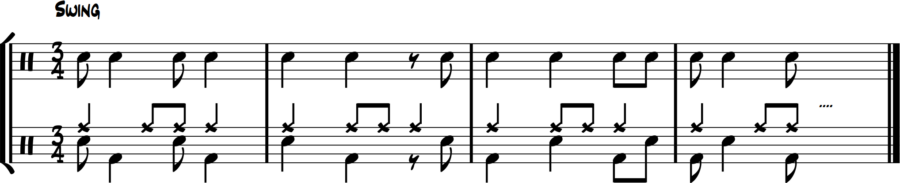
6. Fill in 8th notes on the Bass Drum:
In this exercise, the snare drum (left hand) plays the full syncopated line, while the bass drum (right foot) fills in every eighth-note space between melody notes. The ride cymbal and hi-hat remain steady 3/4 jazz time.
This exercise trains voice leading inversion. The snare drum carries the melodic interest while the bass creates a subtle walking texture, within a 3/4 pulse.
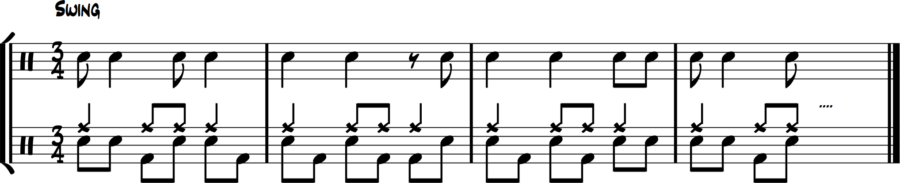
7. Fill in 8th notes on the Snare Drum:
This exercise is the reverse of the previous exercise. The bass drum (right foot) plays the full syncopated line, while the snare (left hand) fills in every eighth-note space between melody notes. The right hand and hi-hat continue 3/4 timekeeping.
This exercise trains a smooth eighth-note foundation. The bass drum carries the melodic phrasing while the snare maintains a flowing texture underneath.
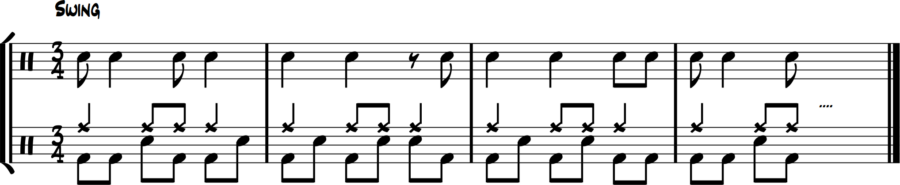
8. Fill in triplets on the Bass Drum:
In this exercise, the snare drum (left hand) plays the full syncopated line, while the bass drum (right foot) fills every empty eighth-note triplet space between melody notes. The ride cymbal and hi-hat maintain a steady 3/4 swing feel.
This exercise trains typical triplet-grid comping. The snare drum carries the melody while the bass completes the rolling triplet subdivision, creating a classic 3/4 swing pocket for medium tempos.
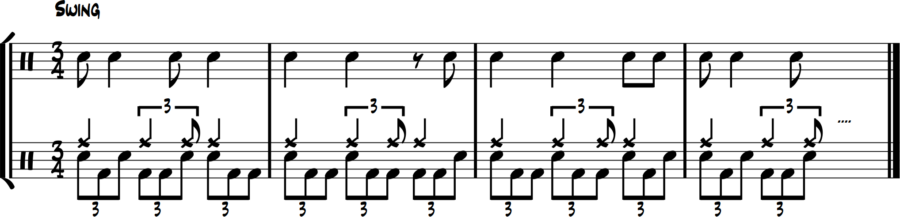
9. Fill in triplets on the Snare Drum:
In this version, the bass drum (right foot) plays the complete syncopated line, while the snare drum (left hand) fills every empty eighth-note triplet space. The ride cymbal and hi-hat keep the 3/4 swing feel consistent.
This exercise trains a smooth rolling triplet pocket. The bass drum drives the syncopation while the snare completes the triplet grid underneath.
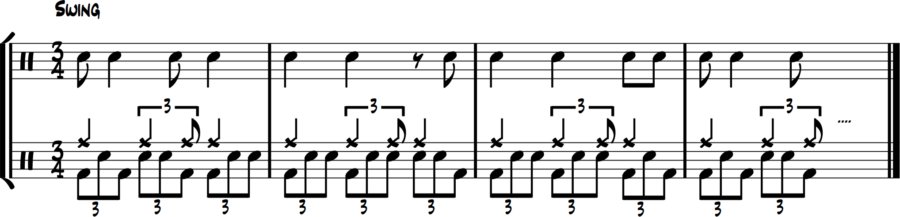
10. Shuffle the melody on Snare Drum:
In this final exercise, the snare drum (left hand) plays a steady eighth-note shuffle. Accent the melody notes while ghosting the notes in between. The right hand keeps standard 3/4 time on the ride cymbal, and the hi-hat (left foot) hits cleanly on 2.
This exercise focuses on dynamic accent control. A steady shuffle feel where melody accents emerge naturally. It builds great internal time and a Max Roach-style phrasing precision.

Download the printable PDF course:
Are you ready for more?
If you’re ready to take it a step further, make sure to check out my lesson on Syncopation in 5/4. If you haven’t done the exercises in 4/4 yet, make sure to check those out! All these exercises offer a collection of brand‑new comping ideas and variations that push coordination and phrasing even deeper.
10 Jazz Drum Comping Hacks (4/4) from Ted Reed’s Syncopation
If there’s one drum book that has quietly shaped generations of drummers, it’s Ted Reed's
10 Jazz Drum Comping Hacks (5/4) from Ted Reed’s Syncopation
10 Jazz Drum Comping Hacks (5/4) from Ted Reed's Syncopation. Rewritten for 5/4 jazz time—8
While you’re here, feel free to explore my growing library of drum transcriptions or other music downloads. All these downloads are designed to help you level up your creativity and overall musicianship. Thank you for reading this post and if it helped you, feel free to share it with other drummers. Let’s keep the groove alive and keep learning together.
Are you enjoying following our Music sections? Please let us know in the comments below! If you’d like to learn more about Yentl’s life as a musician, explore the Projects page for current collaborations or visit Online Education for drum lessons and creative inspiration.
To stay up to date with upcoming music posts, performances, and behind‑the‑scenes stories, follow us on Facebook or check this website regularly. We can’t build this platform without our readers, so thank you for your continued support. Stay tuned for plenty more music and stories to come!