
Essential jazz drumming independence exercises | PDF + MP3 Download

€1,00
Essential Jazz Drumming Independence Exercises.
Upon ordering you get a downloadable digital link containing 2 copies. The link will be valid for 365 days.
What’s included?
-High Definition PDF downloads!
-Play-along MP3 track
-Example MP3 track
– Full Size: Permutations (6) PDF
Essential jazz drumming independence exercises
Grab the PDF and MP3s today to level up your limb independence with structured, fun practice that grows with you!
1. Snare drum independence – Jazz drumming.
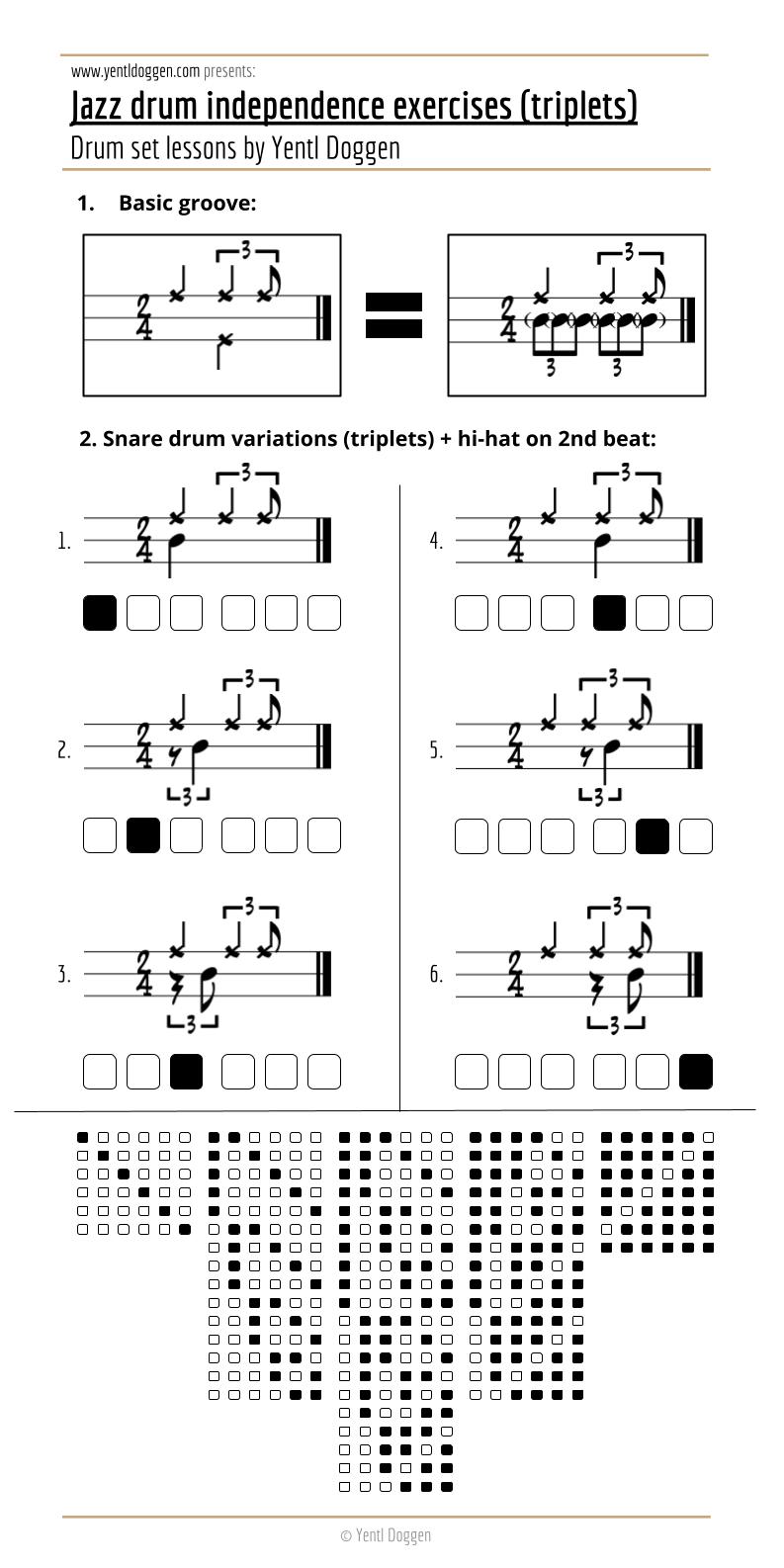
The first drum lesson focuses on the snare drum independence variations in triplets. Exercise one, basic groove, shows the fundamental swing groove we will use in this entire exercise. In the first square, the right-hand plays a standard jazz pattern on the ride cymbal, while the hi-hat, in the left foot, plays on the second beat. The second square represents the notation for the rest of the exercises. The ride cymbal pattern is still there, and while not notated, throughout the following exercises, you should play the hi-hat in the left foot consistently on the second beat. The snare drums are between brackets as a representation of the following practices.
In exercise two, we add the snare drum. The first snare drum comes together with the first ride-cymbal. Afterwards, the snare drum moves to the second and third triplets of the first beat. In the second column, this process repeats itself, only this time the snare drum starts on the second beat, together with the ride cymbal and the hi-hat in the left foot.
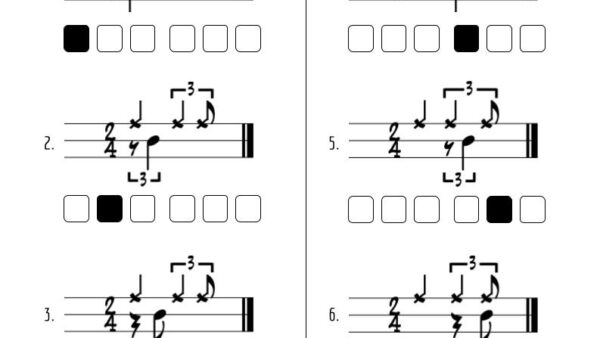
Exercise two shows two different notations. The image on top represents the classical drum notation. The image on the bottom of each activity is for the accompanying permutational visualisation. To finish this drum lesson, we must complete the table at the end of the page according to the same principles above. Two black dots stand for two snare drums, and three black dots for three snare drums, etc. The first drum lesson is complete when all variations (64 exercises) between the single and the whole six black dots are played correctly.
2. Bass drum independence – Jazz drumming.
The second drum lesson focuses on the bass drum independence variations in triplets. Exercise one, basic groove, shows the fundamental swing groove we will use in this entire exercise. In the first square, the right-hand plays a standard jazz pattern on the ride cymbal, while the hi-hat, in the left foot, plays on the second beat. The second square represents the notation for the rest of the exercises. The ride cymbal pattern is still there, and while notated, throughout the following exercises, you should play the hi-hat in the left foot consistently on the second beat. The bass drums are between brackets as a representation of the following practises.
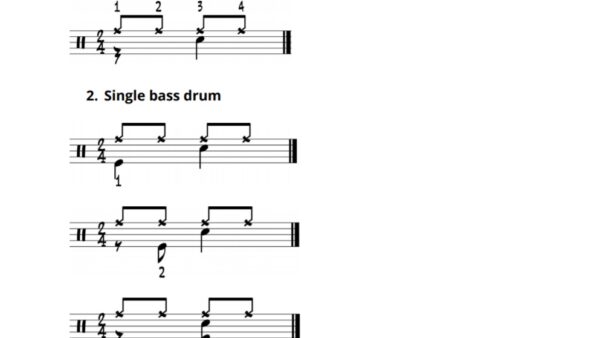
In exercise two, we add the bass drum. The first bass drum comes together with the first ride-cymbal. Afterwards, the bass drum moves to the second and third triplets of the first beat. In the second column, this process repeats itself, only this time, the bass drum starts on the second beat, together with the ride cymbal and the hi-hat in the left foot.
Exercise two shows two different notations. The image on top represents the classical drum notation. The image on the bottom of each activity is for the accompanying permutational visualisation. To finish this drum lesson, we must complete the table at the end of the page according to the same principles above. Two black dots stand for two bass drums, and three black dots for three snare drums, etc. The first lesson is complete when all variations (64 exercises) between the single and the whole six black dots are played correctly.
3. Hi-hat drum independence – Jazz drumming.
The third drum lesson focuses on the hi-hat independence variations triplets in the left foot. Exercise one, basic groove, shows the fundamental swing groove we will use in this entire exercise. In the first square, the right-hand plays a standard jazz pattern on the ride cymbal while the left-hand plays a snare drum rim-click on the second beat. The second square represents the following practises by placing all possible hi-hats in the left foot combinations between brackets.
In exercise two, we add the hi-hats in the left foot. The first hi-hat comes together with the first ride-cymbal. Afterwards, the hi-hat moves to the second and third triplets of the first beat. In the second column, this process repeats itself, only this time, the hi-hat starts on the second beat, together with the ride cymbal and the snare drum rim click in the left hand.
Exercise two shows two different notations. The image on top represents the classical drum notation. The image on the bottom of each activity is for the accompanying permutational visualisation. To finish this drum lesson, we must complete the table at the end of the page according to the same principles above. Two black dots stand for two hi-hats in the left foot, and three black dots for three hi-hats, etc. The first lesson is complete when all variations (64 exercises) between the single and the whole six black dots are played correctly.
Drum Lessons Exercises:
There are multiple essays to write about the benefits of drumming. Playing the drum set reduces stress, develops coordination, activates brain power and makes you feel like a rockstar. Besides, drumming is just incredibly fun, and so is learning new things. From the start, I was always interested in writing drum lessons and exercises for other drummers to keep expanding their skills behind the drum set. There is so much to learn, and there are so many ways to do it. On this page, I will regularly share exercises and lessons for beginners, intermediate and expert drummers to enjoy and grow their knowledge!
My Drum Lessons:
Quality is the number one priority on my website, ensuring that all the drum lessons and exercises on this page or of high quality. Depending on the number and quality of drum activities, some parts are free, and some come as premium products or e-books. All downloads are standard in high-definition PDF or MP3 formats, and you can access two downloads valid for 365 days in your account, reachable on this website or by the email you will receive afterwards. Feel free to message me on the contact page if you have other questions! Start exploring below to find the right fit for you!
About Me:
After finishing my master’s in drums & percussion and a bachelor’s in jazz studies, I started teaching music in my home country, Belgium. When commencing my world travels at the beginning of 2019, I took the opportunity to teach wherever my travels would bring me. Consequently, I have taught music and drum lessons in plenty of places over the past few years. I always did everything possible at every school to ensure my students had the best education possible. Moreover, I started to write Drum Lessons and Drum Transcriptions to give my students everything they need to become great musicians.