

Permutations: Rhythmical Matrix
A Rhythmical Matrix is a fantastic tool for becoming a more creative and precise drummer. It helps you visualize rhythmic groupings and understand how subdivisions interact, opening the door to new coordination ideas and phrasing concepts. Since some of my upcoming drum lessons will focus on rhythmical permutations and matrices, I’d like to share one in particular — a matrix that divides 16 into 4 and 2. This concept is especially useful for drummers working with straight sixteenth-note feels, funk grooves, or linear phrasing patterns in 4/4 time.
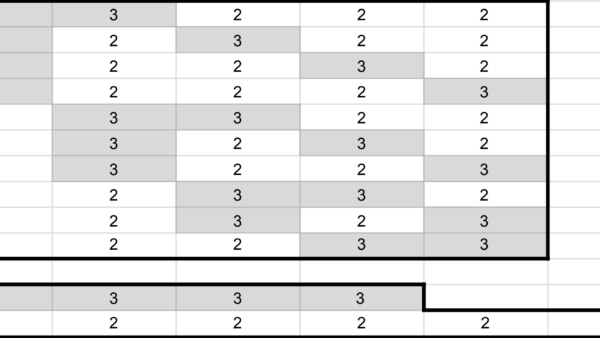
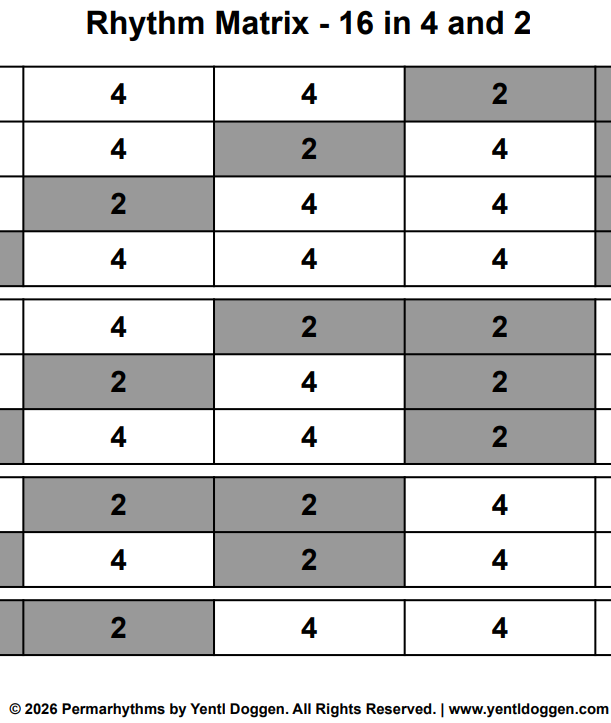
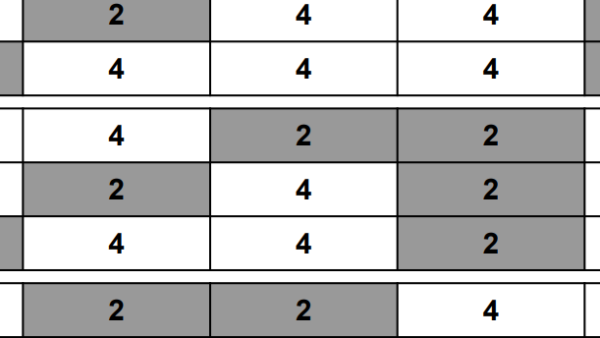
This Rhythmical Matrix provides a clear visual overview of the sixteenth-note subdivision within a 4/4 measure. It forms a strong foundation for countless rhythmic exercises, from comping ideas to advanced coordination drills. You’ll soon find related examples and downloadable exercises on my website. If you’ve ever been a student in my drum classes — whether in person or online — you’ll already know how to apply this matrix effectively in your own practice.
Rhythmical Matrix – 16 in 4 and 2
A rhythmical matrix acts as a guiding map for exploring permutations within specific time signatures or rhythmic values. The goal isn’t simply to create complex rhythms, but to see and understand the mathematical structure behind rhythmic variations. Visualizing rhythm in this way helps you unlock new phrasing possibilities, refine your time awareness, and gain more creative control when orchestrating patterns around the kit.
When dividing rhythmic values, the divisor can never exceed the value itself — because no further variations would exist beyond that point. The number 16 offers a wide range of practical rhythmic options: four groups of four, eight groups of two, or combinations that mix duple and quadruple subdivisions to create syncopation and cross-accented patterns. Each grouping highlights different pulse relationships, making it a great tool for developing precision, groove, and dynamic balance.
Feel free to experiment with whichever configuration feels most natural or challenging. Try writing them out, clapping or counting them aloud, and orchestrating them across the drums and cymbals. As you internalize the structure, the matrix will start to guide your phrasing intuitively — transforming a simple exercise into a creative engine for groove, independence, and improvisation.
Have fun exploring the possibilities of this 16-in-4-and-2 Rhythmical Matrix!