



The 5-dotted permutations are limited in their use but are probably the most fun to play. These exercises will most likely include a five-piece time signature. However, they will be helpful as polyrhythmical structures within an even time signature. When played in a five-piece time signature (5/8, for example), it is up to the player to divide them accordingly to the desired outcome. Popular uses exist but are not limited to a 3 – 2 or a 2 – 3 subdivision.Upon ordering these 4-dotted permutations, you get a downloadable digital link containing unlimited book copies. The link will be valid for 365 days.
What are permutations?
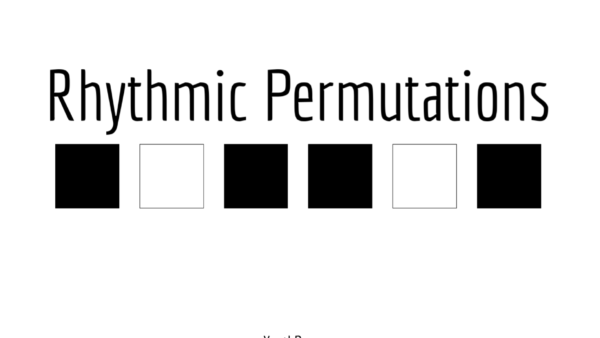
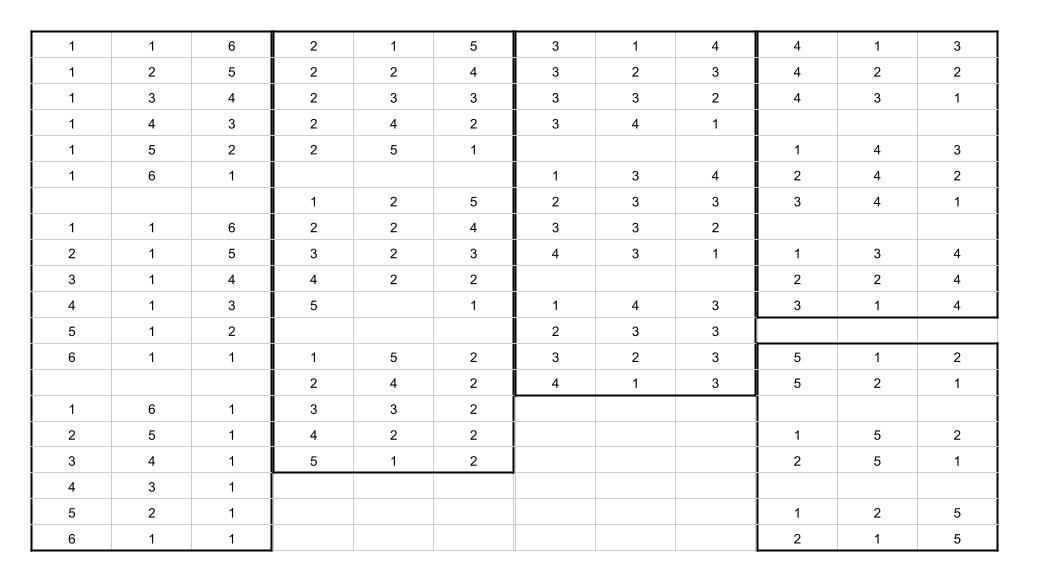
Technically speaking, permutations and combinations are the same. The difference between both, mathematically speaking, is that combinations can occur randomly. In permutations, all these combinations follow a particular order. The Permutations used on the website start on the first beat or dot. Afterwards, that first dot will move one step to the right. Once all the first dot combinations occur, the first dot returns to get the second dot. The same pattern keeps repeating until all variations have systematically passed the revue, creating permutations. For example: if there are three beats, there are three combinations with a single black dot: beats 1, 2 and 3. If we add a second black dot, there are three combinations with double dots: beats 1-2, 1-3 and 2-3. Adding a third black dot means that all the white dots are full, creating permutations. If we evenly divide numbers, we speak of rhythmical matrices.
5-dotted Permutations:
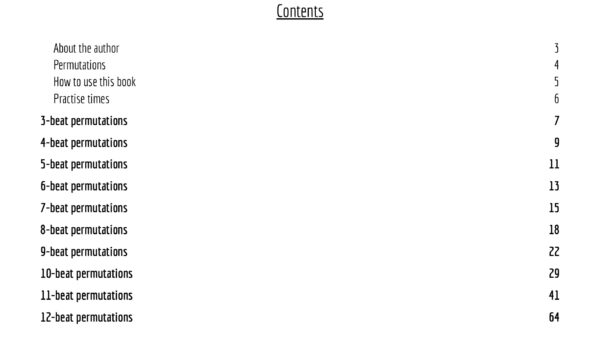
At the start of 2020, this website received a well-deserved makeover to better organize all its content. The redesign created dedicated sections for travelling alongside educational materials. Most drum exercises published here rely on permutations, making this post essential for getting started with any of that material. Currently, only the 3, 4, 5, and 6-dotted systems are available as free downloads. In the future, I plan to publish a comprehensive Permutations book covering variations all the way up to 12-dotted systems.
The core principle driving these rhythmical systems involves systematically working through every possible variation between “no colored dots” and “all colored dots filled.” Each exercise begins with a single dot cycling through every position, then methodically builds through combinations of two, three, and more dots until exhausting all cycles. This exhaustive approach captures literally every rhythmical possibility within the chosen cycle length.