
Permutations: Rhythmical Matrix
A Rhythmical Matrix is an excellent framework for developing creativity, precision, and deeper rhythmic awareness behind the drum kit. It allows you to visualize how subdivisions interact and overlap, helping you uncover new phrasing and coordination ideas. Since several of my upcoming drum lessons will explore rhythmical permutations and matrix-based systems, I’d like to introduce one centered on dividing 12 into 4 and 2.
This concept is particularly valuable for drummers who work within 12/8, 6/8, or triplet-based grooves—commonly found in jazz, Afro-Cuban, and funk settings. The 12-in-4-and-2 Rhythmical Matrix highlights how groupings of four and three interact inside the 12-note structure, creating a bridge between duple and triple time feels.
In practical terms, this matrix visualizes the eighth-note grid of a 12/8 bar or, equivalently, the triplet subdivision of a 4/4 measure. It forms a powerful foundation for rhythm studies—whether you’re working on comping variations, layered ostinatos, or advanced coordination drills. Related examples and downloadable exercises will soon be available on my website. If you’ve ever joined one of my drum classes, you’ll already be familiar with how this system can sharpen your rhythmic control and interpretation.
Rhythmical Matrix – 12 in 4 and 2
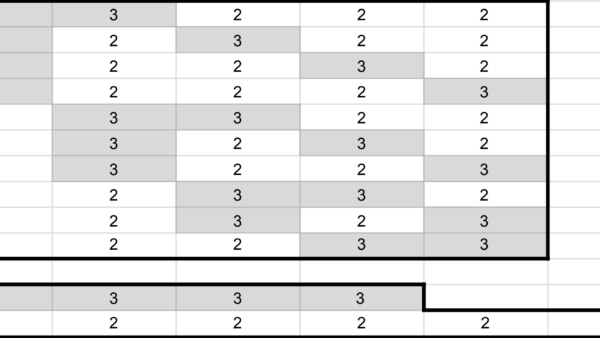
A rhythmical matrix acts as a visual and conceptual guide for exploring permutations within a time structure. The purpose isn’t to complicate rhythm but to clearly see the mathematical backbone that gives it shape. Dividing 12 into groups of four and three showcases two complementary rhythmic flows—straight and swung, even and uneven—that together create compelling tension and release.
The number 12 serves as a versatile rhythmic field: you can organize it as 3×4, 4×3, 6×2, or blend these shapes into hybrid grooves. In the 12-in-4-and-3 configuration, alternating groupings reveal how pulse perception can shift between duple and triple layers—essential for mastering polyrhythms and phrasing across time feels.
Explore each variation hands-on: write them out, clap or count them aloud, then orchestrate them across your kit. Over time, you’ll start to feel the underlying matrix instinctively, transforming it into a creative engine for improvisation, groove development, and soloing ideas.
Enjoy diving into the rhythmic possibilities of this 12-in-4-and-3 Rhythmical Matrix!